
Forcassist vs Data Tools with Forecast Features: Why Simplicity Wins for SMEs
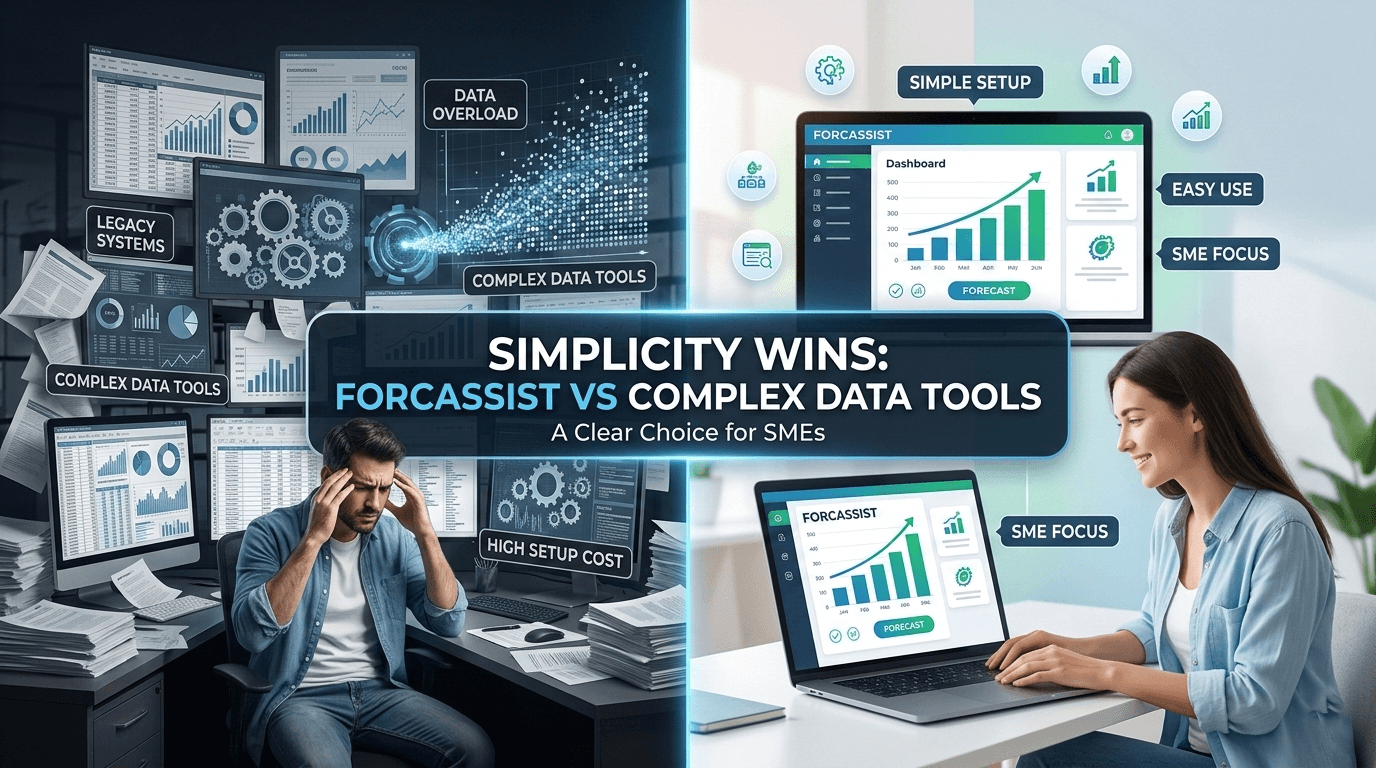
Forcassist vs Data Tools with Forecast Features: Why Simplicity Wins for SMEs
Many growing businesses already use analytics platforms. Dashboards are built. KPIs are tracked. Reports are automated.
And somewhere inside these platforms, there is often a “forecast” button.
Tools like business intelligence dashboards and cloud analytics environments frequently include forecasting features. On paper, this seems ideal. Why buy a dedicated forecasting tool if your existing analytics platform can already generate projections?
The answer lies not in functionality — but in usability, ownership, and strategic alignment.
This article examines the structural differences between general-purpose data tools with forecasting features and a focused AI forecasting platform like Forcassist.
The Illusion of “Built-In Forecasting”
Modern data tools are powerful. They allow:
- Data visualization
- Dashboard creation
- KPI tracking
- Custom metrics
- Basic statistical forecasting functions
For technical teams, these features are flexible.
But forecasting is not a visualization problem.
It is a decision infrastructure problem.
The difference matters.
1. Purpose-Built vs Feature-Embedded
Data Tools with Forecast Features
Forecasting inside analytics tools is usually:
- A secondary feature
- Based on generic time-series models
- Dependent on clean, structured datasets
- Requiring configuration knowledge
The forecasting engine exists inside a broader reporting ecosystem.
It was not built specifically for operational sales prediction.
Forcassist
Forcassist is designed exclusively for:
- Sales data ingestion
- SKU-level pattern detection
- Automated model generation
- Clear forecast outputs
No dashboard construction required.
No query building required.
No formula configuration required.
Purpose-built architecture reduces friction.
2. Technical Skill Requirements
Data platforms often assume:
- SQL familiarity
- Data modeling knowledge
- Dashboard design capability
- Time-series configuration understanding
Even when user interfaces are simplified, forecasting setup often requires interpretation.
Questions arise:
- Which seasonality parameter should we use?
- How many historical periods should be included?
- Should outliers be cleaned manually?
- What smoothing factor is appropriate?
These decisions introduce hidden complexity.
Forcassist’s Approach
Forcassist automates:
- Pattern recognition
- Seasonality detection
- Trend modeling
- Short-term projection logic
The user’s responsibility is simple:
Upload historical sales data.
Receive forecasts.
Technical burden is removed from operational teams.
3. Cost Structure
Many businesses already pay for analytics tools. Forecasting seems “free.”
But indirect costs appear:
- Analyst time spent configuring models
- Iteration cycles to adjust parameters
- Training non-technical staff
- Maintenance of dashboards
Forecasting becomes dependent on specific employees.
If the data analyst leaves, forecasting discipline collapses.
Forcassist reduces:
- Configuration dependency
- Internal technical ownership
- Forecast fragility
The cost is not only monetary. It is organizational.
4. Ownership of Forecasting
In analytics platforms, forecasting often belongs to:
- BI teams
- Data analysts
- IT departments
Sales and operations teams become consumers of reports rather than owners of projections.
This separation creates latency in decision-making.
With Forcassist:
- Sales managers can upload data directly.
- Operations leaders can generate updated forecasts.
- Finance teams can validate projections independently.
Forecasting becomes cross-functional and democratized.
Ownership increases accountability.
5. Accuracy vs Practical Accuracy
Data tools may generate technically correct statistical forecasts.
But forecasting value is not measured by model sophistication alone.
It is measured by:
- Adoption consistency
- Speed of update
- Clarity of output
- Operational usability
If updating forecasts requires rebuilding dashboards, forecasts will not be refreshed frequently.
If forecasts are not refreshed, accuracy declines over time.
Forcassist prioritizes repeatability.
The easier it is to regenerate forecasts, the more accurate your decision cycles become.
6. Infrastructure Dependency
Analytics platforms often rely on:
- Data pipelines
- Data warehouses
- ETL processes
- Continuous integration layers
Forecast reliability becomes dependent on the health of the data infrastructure.
If pipelines break, forecasting stops.
For SMEs without robust IT teams, this introduces risk.
Forcassist operates independently:
- Export sales history from CRM
- Upload file
- Generate forecast
No external dependency.
Operational continuity is preserved.
7. Focus vs Feature Overload
Business intelligence tools are designed to do many things.
Forecasting is one of them.
But when tools attempt to solve everything, cognitive overload increases.
Teams may struggle with:
- Overcomplex dashboards
- Excessive configuration options
- Feature discovery challenges
- Training overhead
Forcassist offers constrained simplicity.
Limited features. Clear outputs. Focused purpose.
Constraint often increases effectiveness.
8. Time-to-Insight
In analytics environments:
- Extract data
- Clean data
- Load into dashboard
- Configure forecast
- Validate output
- Adjust parameters
- Share report
This workflow consumes time.
Forcassist compresses the process:
- Upload data
- Receive forecast
Reduced time-to-insight improves:
- Procurement responsiveness
- Cash flow planning
- Inventory adjustments
- Seasonal preparation
Speed compounds competitive advantage.
9. Strategic Implications for SMEs
SMEs typically operate with:
- Limited data staff
- Lean operational teams
- Tight budget controls
- Rapid decision cycles
Forecasting must support agility, not burden it.
When forecasting depends on analytics specialists, it becomes fragile.
When forecasting is accessible to decision-makers directly, it becomes strategic.
Forcassist aligns with SME operational reality.
10. Scalability Considerations
Data tools scale technically.
But forecasting inside them scales in complexity.
More SKUs → more dashboards.
More data → more maintenance.
More forecasts → more configuration.
Forcassist scales horizontally:
- Upload larger datasets
- Generate forecasts per batch
- Export structured results
No incremental dashboard design required.
11. Psychological Adoption Factor
This is often ignored.
If a tool feels technical, users hesitate.
If forecasting feels like “a data science task,” managers delay engagement.
If forecasting feels like “a simple business step,” it becomes routine.
Routine creates discipline.
Discipline creates predictability.
Predictability creates stability.
Forcassist reduces psychological friction.
12. The Hidden Risk of Over-Engineering
Growing businesses often attempt to replicate enterprise practices too early.
They build complex analytics stacks before operational maturity justifies them.
This creates:
- High fixed costs
- Underutilized infrastructure
- Slow ROI realization
A focused forecasting platform avoids premature over-engineering.
It supports evolution without forcing transformation.
Conclusion: The Right Tool for Operational Forecasting
Data tools with forecasting features are powerful analytical environments.
They excel at visualization, reporting, and multi-metric monitoring.
But forecasting, as a core operational discipline, requires:
- Accessibility
- Repeatability
- Simplicity
- Speed
For SMEs, the objective is not to build a data laboratory.
It is to make better purchasing, inventory, and financial decisions.
Forcassist provides a direct path to those decisions.
In forecasting, clarity often outperforms complexity.
And simplicity, when paired with AI precision, becomes a strategic advantage.